Products » Analytics » Special Applications » Process Gas Chromatography (PGC) » Customized Sampling Systems

Customized Sampling Systems
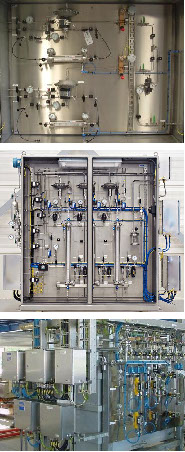
IME SA develops a customized sampling system in partnership with the Dutch multinational for gas chromatography solutions for the Hydrocarbons Processing Industry (HPI).
The main vector of success for the product analysis is to have a representative sampling of it. Therefore, the customized sampling systems optimize the traditional sampling systems adapting the collecting system of the existing industrial process.
By increasing the efficiency and sensitivity levels in the collection, transport and storage of the gas or liquid sample, we obtain a true representation of the actual flow through a process line over a given period (day, week or month).
COMMON APPLICATIONS:
Gas chromatography has its main application in the Hydrocarbons Processing Industry, that converts gas, coal and crude oils into energy, petrochemicals and a wide array of chemical products.
It is usual to check the usage of a customized sampling system in the following cases, up to a limit of 350 bar G:
- Automatic Sampling Systems (time or flow proportional);
- Off-line (bypass) Sampling Pumps for Gas;
- Off-line (bypass) Sampling Pumps for Liquids;
- In-line Isokinetic Pumps for Liquids (manual or automatic insertion/retraction);
- Constant Pressure type Sample Cylinders (50cc to 30USG);
- Atmospheric type Sample Storage Vessels;
- Pressure Sample storage Vessels;
- Automatic Insertion / Retraction sample (including Pilot types);
- Fixed Insertion Regulator Probes (based on Joule Thompson principle);
- Chemical or Odorant Injection System for Gases or Liquids;
- Chemical or Odorant Injection Pumps;
- Chemical or Odorant Injection Probes.
MAIN BENEFITS:
Compared to a traditional sampling system it would be expected to obtain:
- A representative increase of the sample collected;
- Reduction in the complexity of traditional systems (due to the need of adaptation to a wide universe of industrial processes);
- Reduction in operational and maintenance costs and increase of the system’s availability levels;
- Compliance with the safety norms and total adaptation to the norms applicable;
- Total integration with the measuring systems and Process Analysis.